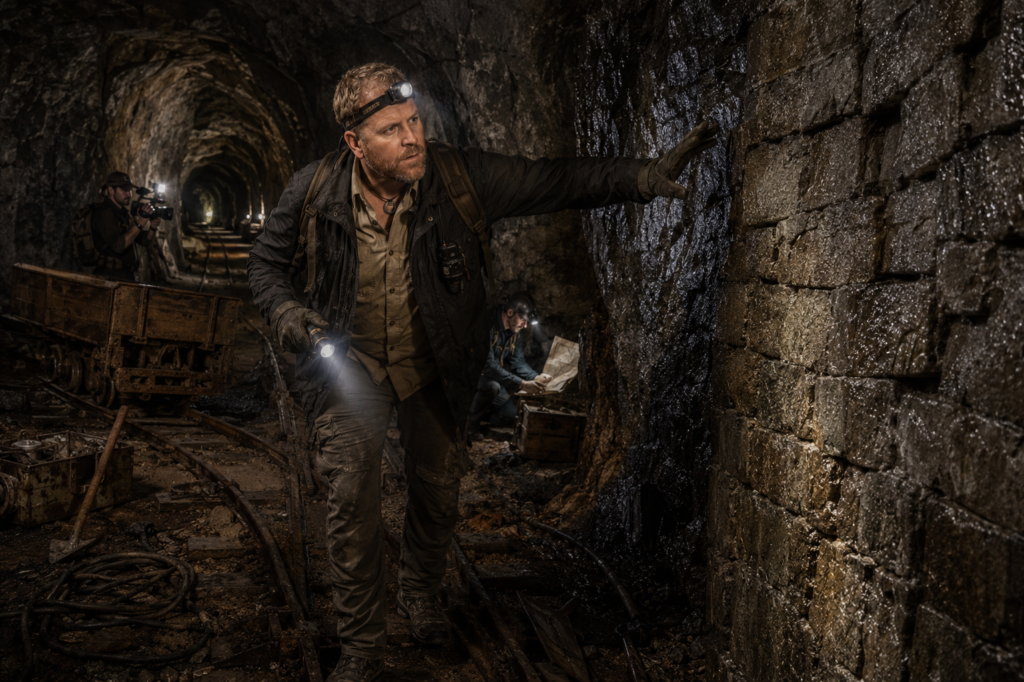
What if the abandoned railway beneath Lubon was never built to carry rubble alone? Expedition Unknown follows Josh Gates and explorer Sebastian into a Nazi tunnel network where a recovered wartime map points toward a major intersection, while a 30-foot wall of stacked stone blocks the route ahead. The deeper the team looks, the more the tunnels begin to resemble something far more deliberate: a hidden underground vault built to disappear before the war ended.
The Nazi Map Points Into the Mountain
Deep beneath the Polish landscape, Josh Gates and Sebastian are following a Nazi map into a tunnel network that appears far larger than the passages visible today. The recovered document identifies a major intersection deep inside Lubon, and the surviving infrastructure seems to confirm that the underground complex was built for sustained wartime operations. Railroad tracks disappear into darkness, electrical cables still cling to the walls, and abandoned mine carts remain scattered through the tunnels, frozen in the moment when construction or transportation suddenly stopped.

For Expedition Unknown, those details matter because they reveal a system designed to move material through the mountain. The rails were not decorative. The carts were not placed there by accident. Something had to be transported through these passages, and the existence of a major intersection suggests that different sections of the complex once connected to a much larger underground network. Yet the strangest feature lies beyond the obvious route: a massive wall of stacked stone roughly 30 feet thick, blocking access to what could be the most important section of Lubon.
The 30-Foot Wall May Be the Real Vault Door
The unfinished branch appears to offer the easiest explanation. Perhaps the work simply stopped when the war ended. But the more closely the team examines the layout, the less satisfying that explanation becomes. Why leave such a thick barrier in exactly the area where the network appears to converge? Why build an entrance system so extensive and then allow the central section to vanish behind what looks almost like natural rock?

That is where the most provocative theory begins. There is no confirmed evidence that the mine carts ever carried gold bullion or looted European artwork, but their existence creates an intriguing possibility. During the final stages of the war, Nazi Germany moved enormous quantities of valuable material while Allied forces closed in. An underground railway would have provided an ideal way to transport cargo out of sight, and a concealed storage chamber could have been sealed when evacuation became impossible.
The 30-foot wall could therefore be more than an unfinished construction feature. It could have been designed as the final barrier of a hidden vault, disguised within the mountain to make the entrance almost impossible to recognize. If so, the unfinished branch may not have been the destination at all.
It may have been the decoy.
What If the Gold Train Was Never Meant to Leave Lubon?
This is where the Lubon mystery becomes enormous. What if the main intersection was the gateway to a protected storage complex, and what if the stone barrier was the final security measure installed when the war was collapsing? The theory that armored train cars carrying Third Reich gold remain somewhere behind the wall is unproven, but it offers a chilling explanation for why such a massive obstruction would have been necessary in the first place.
For Expedition Unknown, the real breakthrough would not simply be finding treasure. It would be proving that Lubon was designed to conceal something whose value justified extraordinary secrecy. A hidden railway system, preserved mine carts, electrical infrastructure, a wartime map, and a barrier 30 feet thick form a compelling chain of clues—but the final answer remains locked behind stone.
If that barrier is ever breached, the discovery could redefine the entire purpose of the complex.
Because the greatest secret beneath Lubon may not be the tunnel they found.
It may be the tunnel they were never supposed to enter.
And somewhere behind 30 feet of stone, the missing fortune of 1945 may still be waiting in the dark.