
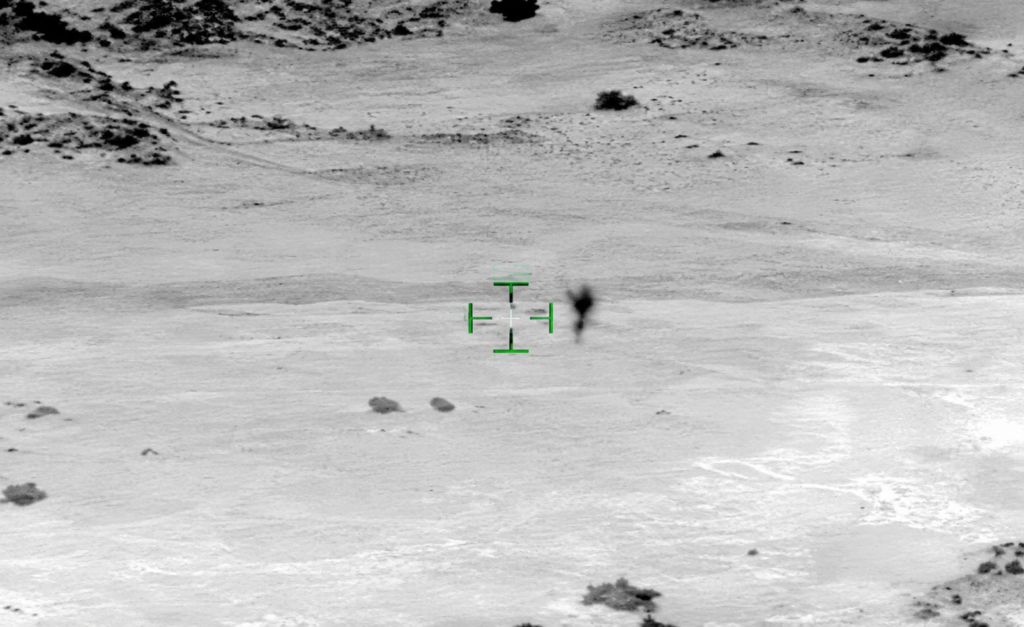
A military infrared camera captured what seemed to be an impossible flight above the Mediterranean: a dark, round object racing toward Mount Etna and apparently passing straight through the volcano’s superheated plume without slowing, burning, or changing course. For years, the footage carried the visual power of extraordinary technology moving through an environment that should have destroyed anything fragile. Then analysts began rebuilding the scene not as the camera presented it, but as it may actually have unfolded across a far greater distance. The result did not make the video less haunting. It revealed how easily a military sensor can turn an ordinary object into something that appears to violate physics.
The Object That Seemed to Enter the Volcano
The footage was recorded in December 2018 by a shortwave infrared camera aboard a U.S. military uncrewed aircraft operating over the Mediterranean Sea south of Sicily. The camera was observing Mount Etna during an eruption when a small round object entered the frame and remained visible for several minutes. Against the violent background of smoke, heat, ash, and rising volcanic gas, the object appeared to move with unnerving confidence. It seemed fast, stable, and almost completely unaffected by the chaos around it. Then came the moment that transformed the clip from unusual military imagery into an apparent challenge to conventional aviation: the object appeared to pass directly through the volcanic plume. There was no visible loss of altitude, no sign of structural damage, and no sudden change in bearing. The dark shape simply continued

across the screen as though the superheated cloud were nothing more than empty air. Visually, it was devastating. A balloon should have been overwhelmed. A bird should have disappeared. A conventional aircraft should never have been placed in such a position. The scene appeared to leave only the most dramatic explanation standing that the camera had captured a craft capable of surviving conditions ordinary technology could not endure. Yet the image contained a hidden weakness. Infrared footage compresses a three-dimensional world into a flat screen, and without reliable distance information, two objects separated by more than a hundred kilometres can appear to occupy the same patch of sky. The alleged encounter with the plume may therefore have been created not by impossible propulsion, but by the camera’s inability to show depth.
Read more: https://showscope.truyengi.me/travis-recovers-a-burning-uap/tqh/
The Volcano Was Closer Than the Object
When analysts reconstructed the event, the terrifying visual story began to fracture. The object may not have been near Mount Etna at all. Weather data, cloud layers, wind direction, sensor geometry, and the motion of the observing aircraft suggested that it was much closer to the camera and approximately 170 kilometres from the volcano. That distance changes everything. Instead of a craft racing into volcanic ash, the footage may show a small object drifting across the foreground while Etna’s plume rises far behind it. The apparent speed could have been intensified by motion parallax, the same effect that makes nearby roadside objects seem to rush past while distant mountains barely move. Because the military camera itself was travelling, the object’s movement across the frame did not necessarily represent extraordinary speed through the atmosphere. Analysts

also examined the brightness of the object’s pixels compared with the pixels immediately surrounding it. Had the object genuinely entered the thick volcanic plume, its infrared appearance should have changed as ash, heat, and gas obscured or altered the signal. Instead, the object’s visual signature remained consistent with something passing in front of the plume rather than through it. Three-dimensional modelling then placed the object on a wind-driven path compatible with a balloon. Even when it became difficult to see, faint traces reportedly appeared in the region where the reconstruction predicted it should continue travelling. The impossible craft had not conquered the volcano. It may never have approached it.
A Solved Case With an Uncomfortable Warning
The Mount Etna case is powerful because the explanation does not depend on accusing witnesses of dishonesty or pretending the original footage was unimpressive. The video genuinely looked extraordinary. The sensor was real, the military platform was real, and the object remained unidentified when first observed. What changed was not the recording but the amount of context available around it. A single dramatic frame encouraged the eye to connect the object with the plume, while the rebuilt scene separated them across an enormous distance. That gap exposes one of the deepest problems in UAP investigation: advanced sensors can produce precise imagery without producing complete understanding. Infrared cameras reveal heat differences invisible to the eye, but they do not automatically provide an intuitive sense of scale, depth, or distance. A moving aircraft, a narrow field of view, a distant background and an unknown object can combine into a convincing illusion of speed and impossible performance. AARO ultimately assessed with moderate confidence that the object was likely a balloon drifting with the wind, not a vehicle

penetrating superheated ash. “Moderate confidence” matters. It does not transform every unresolved detail into certainty, but it shows that the most dramatic interpretation was no longer required by the evidence. The case therefore ends with a twist more unsettling than a simple debunking. The camera did not invent the object; the human mind completed the scene. It placed the object beside the volcano, gave it impossible speed, and turned overlapping lines of sight into a direct collision with nature’s most violent forces. For several minutes, an ordinary drifting object may have worn the appearance of technology beyond human capability. The footage remains a warning that the most shocking UAP videos may hide their answer not inside the object itself, but inside the missing distance between the camera, the target, and the story our eyes build around them.






