
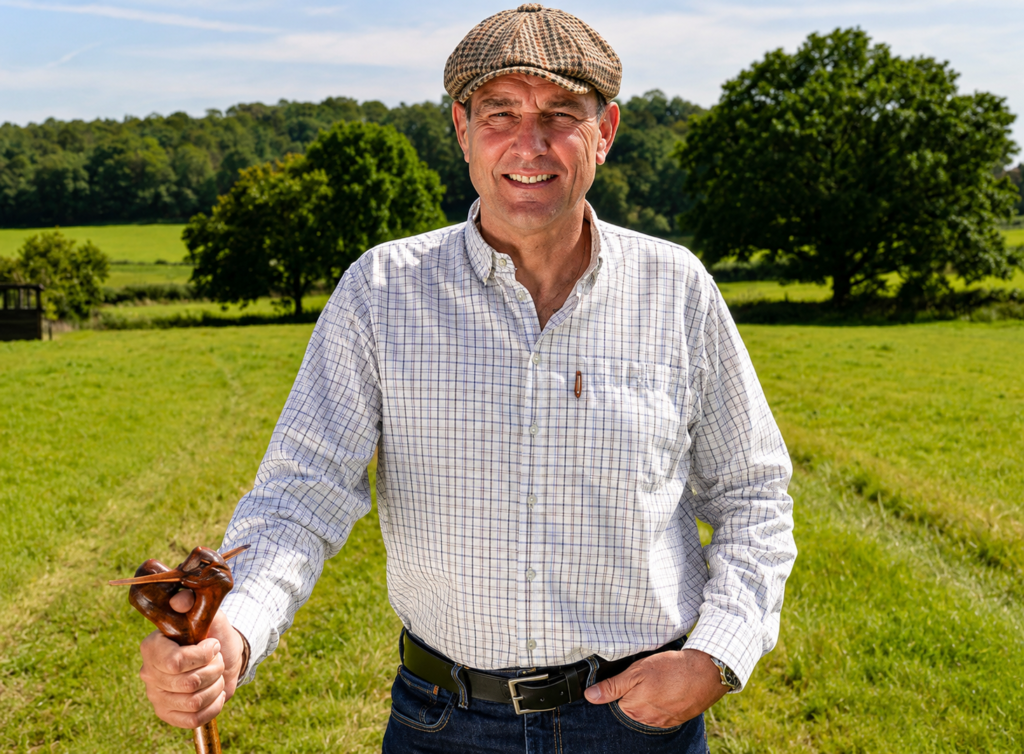
Vinnie Jones has had enough of one comparison following him around the countryside. His rural series keeps being pushed into the same box as Clarkson’s Farm, and he has made it clear that he thinks the comparison misses the point. Yet just when the story looks ready to become another celebrity rivalry, Jones does something far more interesting: he turns around and gives Jeremy Clarkson perhaps the biggest compliment a rival countryside presenter could offer.
Vinnie Jones Wanted His Own Rural Story
The problem for Vinnie Jones began before viewers had much chance to decide what his programme actually was. Put a famous British man in the countryside, surround him with machinery, muddy boots, livestock and rural characters, and Clarkson’s Farm immediately becomes the comparison waiting at the gate. Jeremy Clarkson had already turned Diddly Squat into one of television’s most recognisable rural locations, complete with oversized tractors, agricultural disasters and Kaleb Cooper appearing at regular intervals to explain why Jeremy’s latest brilliant idea was, in fact, agricultural nonsense. So when Vinnie Jones in the Country arrived, the shorthand was irresistible: another celebrity leaves the world that made him famous, heads into the

countryside and discovers that nature has absolutely no interest in his reputation. Jones, however, has pushed back against the idea that he simply followed Clarkson’s blueprint. His show is built around a different relationship with the land, with greater emphasis on conservation, wildlife, restoration projects and the emotional connection he has developed with country life. The irritation is easy to understand. Imagine spending years building something personal only for every description to begin with somebody else’s name. Clarkson’s Farm had become so dominant that apparently the British countryside now required one celebrity franchise owner. Yet Jones’s frustration is not really with Jeremy himself. It is with the assumption that two rural programmes must be competing for the same tractor-shaped throne. The similarity is obvious enough to create the conflict, but once the cameras move beyond the fields, the programmes begin pulling in different directions.
The Copy Claim Starts to Collapse Once You Look at What the Two Men Are Actually Doing
Clarkson’s Farm runs on agricultural jeopardy. Jeremy has a plan, Kaleb looks horrified, Charlie Ireland discovers the cost, Lisa Hogan points out the practical consequence, and somewhere in Oxfordshire a machine prepares to break at exactly the wrong moment. Farming is the engine of the story because Diddly Squat has to survive as a working business. Crops need to make money. Animals need looking after. Weather can erase months of work with the enthusiasm of a man wiping a whiteboard. Vinnie Jones’s rural world operates differently. The countryside is less an opponent he is trying to conquer and more a place he is trying to understand, restore and protect. Wildlife, land management, construction and personal reflection sit much closer to the centre. That does not mean there are no similar ingredients. Both men are blunt personalities. Both programmes benefit from the comedy created when

celebrity confidence encounters people with actual rural expertise. Both contain machines, mud and the deeply British discovery that any outdoor project can become considerably more expensive the moment somebody says the words “should be straightforward.” But sharing those ingredients does not automatically make one programme a copy. If that were the rule, every cooking show would be guilty because somebody eventually uses an oven. Jones has also made clear that he does not resent Clarkson’s success. In fact, this is where the supposed rivalry becomes much less satisfying for anyone hoping for a television feud involving two angry men shouting over a fence. Jones may dislike having his programme reduced to “another Clarkson’s Farm,” but his criticism stops well before it reaches Jeremy personally. The conflict is with the label, not the man who accidentally made rural television fashionable enough that everyone arriving afterwards would be measured against him.
Vinnie’s Biggest Pushback Ended With the Compliment Clarkson Probably Deserved Most
The most revealing part of Jones’s response comes when the confrontation should, by tabloid logic, become nastier. Instead, he credits Jeremy with having done “a fantastic job raising awareness for farmers.” That line changes the entire story because it identifies the one thing about Clarkson’s Farm that even someone tired of being compared with it is unwilling to dismiss. Clarkson began Diddly Squat with the confidence of a man who believed farming was largely a matter of purchasing sufficiently impressive equipment. He then spent season after season discovering that weather, costs, regulations and livestock could defeat a television personality without even knowing who he was. Kaleb corrected him. Charlie warned him. The bank balance occasionally mocked him. And while Jeremy was busy being publicly educated, millions of viewers were being educated with him. Farming stopped being the invisible industry sitting

behind supermarket shelves and became something audiences watched fail, recover and struggle in real time. That is the achievement Jones is recognising. His compliment does not require him to accept that his own programme belongs in the same category, nor does it mean the two men suddenly share identical views about the countryside. It simply acknowledges that Clarkson used his enormous audience to make people pay attention to farmers who rarely receive that level of attention. In a strange way, Vinnie’s irritation may be evidence of just how successful Jeremy has been. Clarkson’s Farm became such a powerful reference point that another celebrity can barely walk into a field without being compared to it. Jones wants out of that shadow, and fairly so. But he is not trying to knock down the man who created it. He is saying the programmes are different while admitting Clarkson did something genuinely important. The rivalry therefore ends in the least dramatic way possible: with respect. And somewhere at Diddly Squat, Jeremy may finally have achieved the impossible—a compliment from another famously uncompromising man without having to buy a single enormous machine.






