
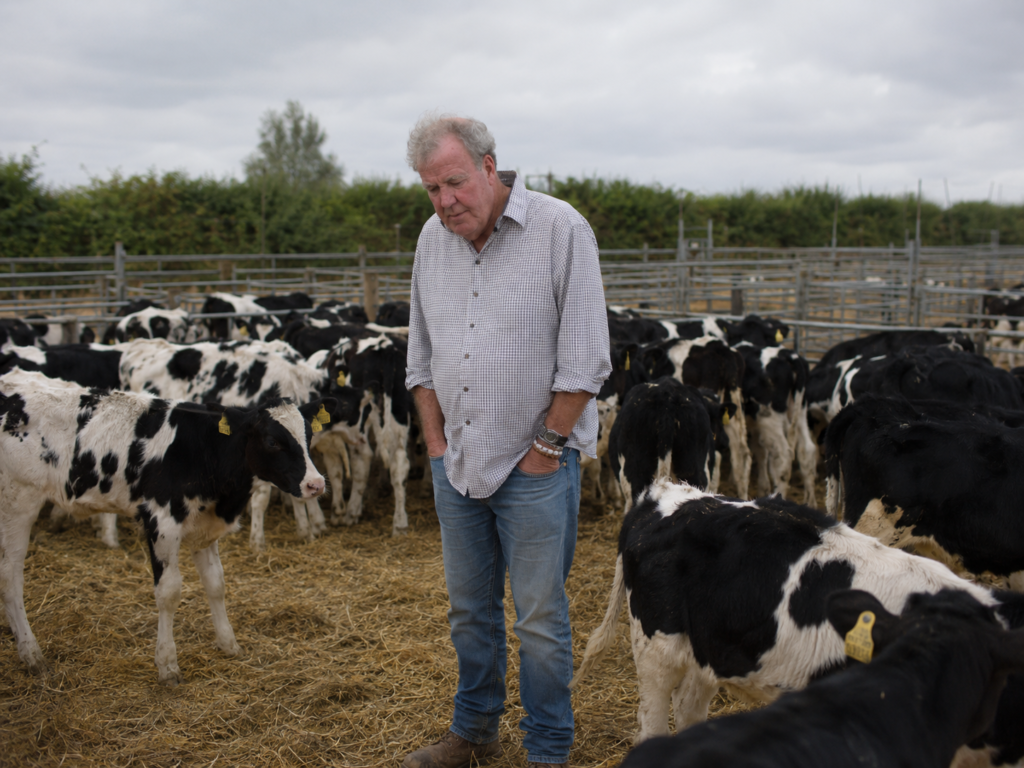
Jeremy Clarkson has spent five seasons learning that farming can be undone by rain, prices, machinery and bureaucracy. But bovine tuberculosis introduced Diddly Squat to something different: a disease capable of placing a cattle business under severe restrictions almost as soon as it is detected. Now Clarkson is taking that experience beyond his own herd, travelling around Britain to meet farmers, vets, scientists and politicians as the issue appears set to become one of Season 6’s most serious investigations.
Diddly Squat’s TB Outbreak Changed the Meaning of a Bad Day on the Farm
Bovine TB stopped being an abstract farming problem for Clarkson when Diddly Squat suffered its own outbreak. Clarkson announced in 2025 that the farm had “gone down with TB”, describing everyone there as devastated. The disease, caused by Mycobacterium bovis, remains one of the most persistent animal-health problems facing cattle farming in England. The consequences can move quickly. When infection is identified, movement restrictions can prevent cattle being freely bought or sold, testing becomes central to what happens next, and animals considered infected or high-risk can be compulsorily slaughtered. For a cattle farmer, that means the problem is not limited to one sick animal. An entire herd and the economics surrounding it can suddenly be affected.

Clarkson’s Farm gave that reality a particularly uncomfortable human face. The series had already shown Jeremy becoming attached to cattle that originally arrived as another diversification idea, but TB forced him into a world where emotional attachment had almost no influence over official disease-control procedures. One of the most difficult moments involved a pregnant cow being removed after inconclusive testing, only for the subsequent examination not to confirm TB in that animal. For Clarkson, the experience raised obvious questions about testing, compulsory slaughter and what farmers are expected to accept in the name of controlling disease. But the important distinction is that his frustration does not mean the controls themselves exist without reason. Bovine TB can spread between cattle and wildlife populations, and managing that risk has challenged governments, vets and farmers for decades. What changed at Diddly Squat was Jeremy’s position. He was no longer commenting from outside. Suddenly, the regulations, uncertainty and potential financial damage belonged to his farm.
Read more: https://showscope.truyengi.me/jeremy-clarksons-quiet-thanks-to-lisa/tqh/
Clarkson Is No Longer Just Complaining About TB, He Is Going Looking for Answers
That appears to be where Season 6 takes the story in a different direction. Clarkson has said he is spending considerable time travelling around Britain speaking with vets, scientists, politicians and farmers to better understand bovine TB and what might realistically be done about it. He has even mentioned speaking with Queen guitarist Brian May, whose long-running opposition to badger culling has placed him on a very different side of one of Britain’s most contentious rural debates. Clarkson also indicated that a film crew was accompanying him, strongly suggesting that at least part of this investigation may appear in a future television programme. Season 6 is already in production, making bovine TB one of the clearest emerging threads around the next chapter of Clarkson’s Farm.

That represents a significant change in Jeremy’s role. Earlier seasons usually followed the same basic direction: a farming problem arrived at Diddly Squat, Jeremy attempted to solve it, and Kaleb Cooper or Charlie Ireland explained why his solution was either impractical, expensive or impossible. With TB, Clarkson appears to be moving outside the farm because there is no simple Diddly Squat solution. He cannot buy a larger tractor, open another business or wait for better weather. The problem involves testing science, cattle movements, wildlife, vaccination, government rules and disagreement over how infection should be controlled. England is already considering a new long-term approach, with an expert-led strategy aiming for officially bovine-TB-free status by 2038 and an ambition to introduce cattle vaccination from 2030. More than 20,000 cattle in England were slaughtered in 2025 in connection with TB control, illustrating why this is far larger than one television farmer’s bad experience. One possible interpretation is that Clarkson is using Diddly Squat as the starting point for something the programme has increasingly done well: taking a complicated agricultural problem and making viewers understand why farmers care about it.
Season 6 Could Turn Diddly Squat’s Worst Cattle Crisis Into Its Biggest Farming Investigation
That could give Season 6 a very different kind of storyline. Clarkson’s Farm normally makes agricultural problems understandable by showing their consequences first. Viewers see the ruined crop before hearing about yield. They watch Charlie calculate the costs after Jeremy has already spent the money. With bovine TB, the same formula could expose an issue that is simultaneously scientific, political and deeply personal. Farmers want healthy herds and workable businesses. Scientists want disease-control measures supported by evidence. Government has to consider animal health, trade and public money. Wildlife campaigners challenge approaches involving badgers. Those interests overlap, but they do not always produce agreement. The government’s new strategy itself reflects that complexity, combining improved testing, vaccination ambitions and measures intended to reduce transmission rather than presenting a single simple cure.

Clarkson is unlikely to personally solve bovine TB, and Season 6 should not be framed as though one television programme can end a disease Britain has struggled with for generations. What he can do is make its consequences visible. That may be particularly valuable because cattle TB can appear almost invisible until a test changes everything. There may be no dramatic storm rolling across the farm and no broken machine sitting in a field. Instead, a test result can suddenly restrict cattle movements, force difficult decisions and place months or years of breeding work under threat. That is the frightening reality Clarkson encountered at Diddly Squat. His response now appears to be characteristic, but more focused than usual: if he does not understand the system, he is going to find the people who do and keep asking questions. Season 6 may therefore begin with one Oxfordshire farm’s experience but end up examining a problem affecting cattle farmers across the country. Jeremy spent his first years at Diddly Squat learning how to keep cows. Bovine TB has now pushed him toward a much harder question—how do you protect an entire farming industry from a disease that can change the future of a herd before the farmer has any chance to stop it?






