
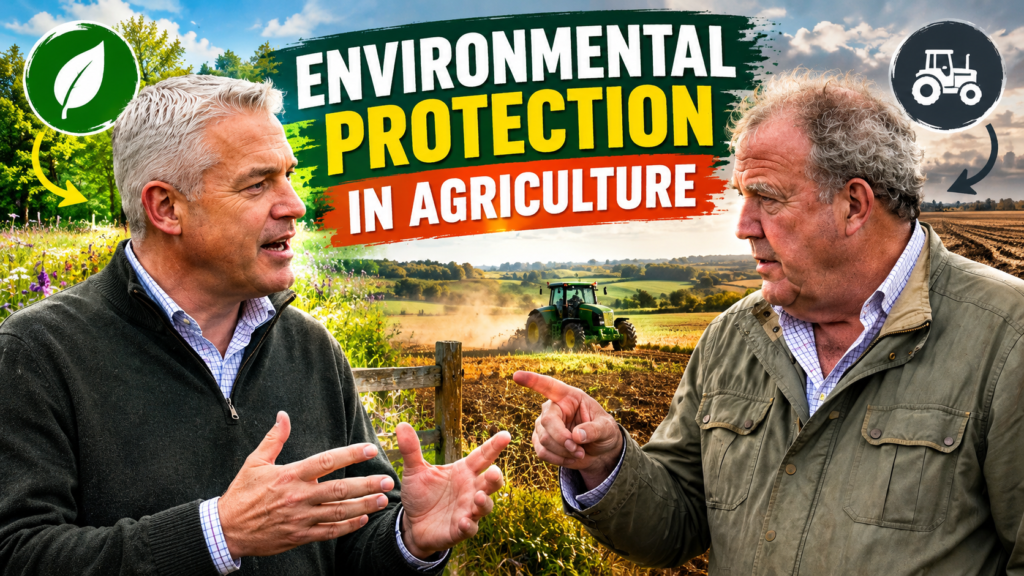
Jeremy Clarkson’s latest criticism has once again pushed Diddly Squat into the middle of a much bigger argument about British farming. What begins as another clash over agricultural policy quickly raises a far more uncomfortable question: how can Britain demand more from farmers environmentally while making sure they can still afford to produce food? As extreme weather, rising costs and changing farming policies collide, Diddly Squat has become an unlikely stage for one of the country’s most important debates.
What looks like another Clarkson argument is really a fight over farming’s future
Jeremy Clarkson has never been particularly good at keeping quiet when he believes farmers are being misunderstood.
That is part of what made Clarkson’s Farm so compelling in the first place. What began as a television experiment gradually turned into a window through which millions of people could see the pressures behind modern agriculture.
Now Diddly Squat is once again sitting at the centre of an argument that extends far beyond one farm.
Clarkson’s criticism of Steve Barclay has reopened a familiar tension: environmental policy on one side, agricultural survival on the other. The question is not whether the environment matters. It clearly does. The harder question is what farmers are expected to sacrifice in order to protect it — and whether the economic burden is becoming too heavy for the people expected to carry it.
That debate could hardly be more relevant.

England’s farmers manage around 68% of the country’s land, while agriculture is also responsible for a significant share of water pollution. At the same time, the government’s own latest farming strategy acknowledges that extreme weather and climate change are creating growing risks for agriculture and says farming needs to become both profitable and environmentally resilient.
That contradiction sits at the heart of Clarkson’s argument.
Farmers are being asked to protect soil, water and biodiversity while simultaneously producing affordable food and keeping their businesses alive.
Those goals do not necessarily have to conflict.
But achieving all of them requires money, time, infrastructure and policies that farmers can actually work with.
That is where the frustration begins.
Diddly Squat has become a symbol of the pressure ordinary farmers rarely get to show the public
One reason Clarkson’s complaints attract so much attention is that Diddly Squat provides a visual version of problems that are otherwise difficult to understand.
A policy document can talk about incentives, environmental outcomes and sustainable farming.
Clarkson can show what happens when the numbers simply stop working.
He recently claimed that he works between 15 and 20 hours a day at Diddly Squat during the summer yet does not actually receive a wage from the farm’s produce, while also arguing that making money from growing food has become increasingly difficult.
That makes the wider environmental debate much more complicated.

A farmer who cannot make enough money from farming cannot simply be told to invest more in new equipment, change production methods, improve water management and adopt additional environmental measures without also being given a realistic way to pay for those changes.
This is where the argument needs to move beyond Clarkson himself.
Whether people admire him or find him infuriating is almost beside the point.
The underlying problem exists independently of Diddly Squat.
British agriculture is already dealing with severe weather disruption. Reuters reported this month that the UK and Europe are experiencing major agricultural losses from heat and drought, while farmers are increasingly looking toward regenerative techniques, improved soil health and better water retention to make their businesses more resilient.
The Times has similarly reported that the current heat and drought have damaged crops and livestock production, with some farmers reporting losses of up to one-third in particular crops.
In other words, Clarkson’s frustration is arriving at a moment when the environmental and economic questions are becoming impossible to separate.
The farmer needs a healthier environment.
But the farmer also needs a healthy business.
Without the second, there may not be a farm left to protect the first.
The real challenge is finding a system farmers can actually survive
Perhaps the most interesting part of this debate is that the answer does not have to be “farmers versus the environment”.
That is too simple.
Modern agriculture can potentially become both more productive and more environmentally resilient. The government’s new 25-year farming roadmap explicitly describes its ambition as making English farming profitable, productive, sustainable and resilient, while encouraging measures such as improved soil health and water management.
The question is whether those ambitions can be translated into everyday reality.
A farmer cannot run a business on good intentions.
If an environmental measure requires additional labour, equipment or lost production, there has to be a financial reason for the farmer to adopt it. If a policy changes every few years, farmers become understandably reluctant to make expensive long-term investments. And if extreme weather is already destroying harvests, asking farmers to absorb more uncertainty without better infrastructure could simply push vulnerable businesses closer to the edge.

That is why Diddly Squat has become such an effective symbol.
The farm shows the gap between policy on paper and agriculture in the field.
The cameras capture the frustration. The machinery bills are real. The weather is real. The failed experiments are real. And increasingly, the question of whether food production remains financially viable is impossible to hide behind political language.
At the same time, there is a danger in allowing Clarkson to become the only voice in the conversation.
His experience is valuable, but British agriculture is far larger and more complicated than one farm in Oxfordshire. The future will require farmers, environmental groups, policymakers, food companies and consumers to find common ground rather than simply trading accusations.
That is ultimately what makes the Clarkson-Barclay dispute interesting.
The personalities may generate the headlines.
But the real story is much bigger.
Why this debate could define the next chapter of Diddly Squat
Diddly Squat has spent years evolving from a farm into a business, a television phenomenon and an increasingly influential symbol of British agriculture.
That means every new controversy surrounding it now carries more weight than it once did.
When Clarkson complains about farming policy, millions of people hear it.
When policymakers defend environmental measures, millions of people can compare those arguments against what they have seen happening at Diddly Squat.
That makes the farm an unusual kind of public laboratory.
It shows what agricultural policy looks like when it reaches a field.
And perhaps that is the most valuable role Clarkson’s Farm can play.
The show does not need to solve the conflict between farming and environmental protection. It needs to make the conflict visible enough that people are forced to think about it.
Because the future cannot simply be about producing more food at any cost.

Nor can it be about protecting nature while ignoring whether farmers can afford to remain on the land.
Britain needs both.
The challenge is finding a system where environmental progress does not become an economic punishment, and where agricultural productivity does not come at the expense of the natural resources farming ultimately depends on.
That is the debate Diddly Squat has stumbled into.
And as the farm enters another difficult season, with extreme weather already putting further pressure on British agriculture, Jeremy Clarkson may once again find himself at the centre of a conversation far bigger than himself.
The argument may have started with Clarkson and Steve Barclay.
But the question now belongs to everyone:
How does Britain protect the countryside while making sure the people who feed the country can still afford to farm it?
That is a much harder question than any television feud — and Diddly Squat may have become one of the most unlikely places to force Britain to confront it.


