
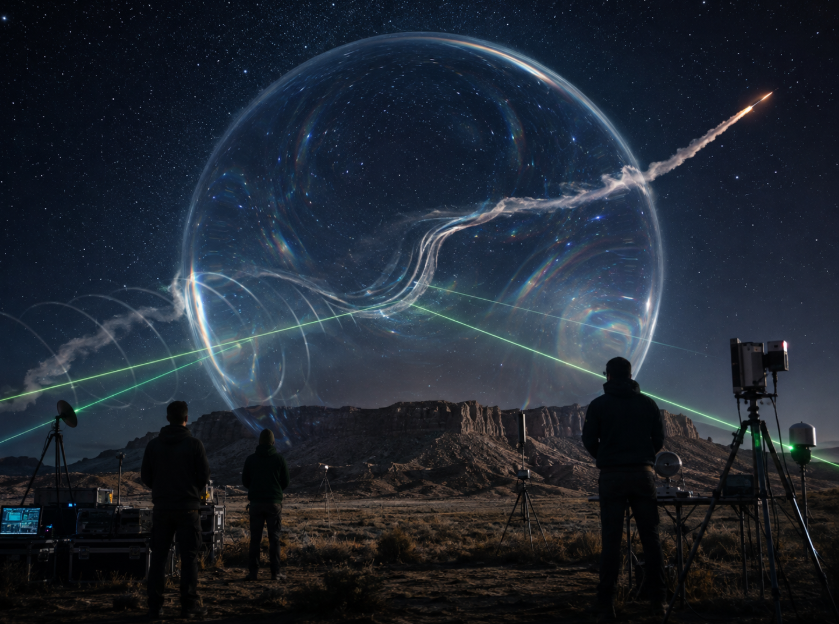
A strange GPS reading can be blamed on electronics. A distorted smoke ring can be blamed on wind. A rocket deflection can be blamed on aerodynamics. But Skinwalker Ranch is beginning to produce all of them around the same suspected bubble-like region. Solid objects, air, RF systems, GPS, microwaves, and now even laser light appear to be reacting in different ways. If those events share one cause, the team may be dealing with something far more complicated than a conventional electromagnetic disturbance.
ROCKETS AND DRONES SUGGEST THE ANOMALY CAN PUSH BACK AGAINST SOLID MATTER
The first category is the hardest to ignore because it involves physical objects moving through open air. Rockets launched into suspected anomalous zones have repeatedly behaved in ways that drew the team’s attention, including abrupt deviations around specific altitudes and trajectories that seemed to normalize only after leaving the region. Drones and other airborne systems have also produced strange behavior around areas associated with the bubble. Any single incident can be explained conventionally. Rockets are affected by thrust, wind, stability, and mechanical failure; drones depend on software, GPS, and control links. But the repeated appearance of problems around the same invisible region gives the team a reason to ask whether something local is interfering with them.

That question becomes especially provocative when the anomaly appears to influence not only the electronics inside an aircraft but its physical path. If a rocket truly changes direction as it crosses the boundary, then the team is not simply measuring a corrupted signal. Something in the environment may be altering the motion of matter itself. That is an enormous distinction. A purely electronic anomaly should scramble instruments without necessarily pushing a physical object off course. Yet the bubble theory has increasingly been built around exactly that uncomfortable combination: systems fail while objects also appear to react. If the team can reproduce those deviations with inert projectiles carrying no GPS or radio equipment, the mystery would deepen dramatically because software and RF interference would no longer be enough to explain what happened.
THEN THE AIR AND ELECTRONICS BEGIN REACTING TOO
The second and third domains make the bubble even harder to reduce to one ordinary mechanism. Smoke rings have been used as tracers specifically because they contain no guidance system, no GPS receiver, and no onboard electronics. They are simply moving air and suspended particles. Yet some of the rings have distorted, stretched, or broken apart while passing through the suspected anomaly, sometimes after earlier rings traveled much more cleanly under similar conditions. Wind and turbulence remain obvious explanations, but repeated deformation in the same region could imply that the local atmosphere is being disturbed.

At the same time, the ranch has produced a completely different family of anomalies involving electromagnetic systems. GPS devices have reported strange positions and impossible looking tracks. Radio-frequency activity has appeared at unusual times. Microwave and communication systems have behaved unpredictably during experiments. Those events fit much more comfortably inside an electromagnetic model—but the smoke does not. That is the problem. If one phenomenon is responsible for both categories, it would need to influence gaseous motion while also interfering with electronic signals. The more systems the team compares simultaneously, the less satisfying any single narrow explanation becomes. An RF source might corrupt GPS. Atmospheric turbulence might deform smoke. Aerodynamics might move a rocket. But if those effects begin at the same location, after the same stimulation, and at the same moment, the ranch would be forcing investigators to consider that they are seeing different symptoms of one larger interaction.
IF THE LASERS ARE ALSO AFFECTED, THE BUBBLE MAY CROSS FOUR DIFFERENT DOMAINS
Light may be the most provocative piece of the puzzle. The team has used multiple lasers to create straight reference lines through the suspected bubble, hoping that any bending, blocking, displacement, or deformation would reveal where the invisible boundary actually sits. A laser should provide geometry the investigators can predict with exceptional precision. If a beam appears to shift or disappear, reflections, smoke density, camera perspective, and atmospheric refraction must all be tested first. But if repeated experiments show laser behavior changing in the same region where rockets deviate, smoke distorts, and GPS systems fail, the anomaly would appear to touch four very different domains at once: solid matter, the atmosphere, electromagnetic electronics, and potentially light propagation itself. That would be difficult to explain with a simple localized RF source. It would also change how the team should investigate the ranch. Instead of running separate rocket tests, smoke tests, laser tests, and electronic surveys, all four systems could be synchronized around one stimulus. An inert projectile could cross the boundary while smoke maps airflow, laser grids monitor optical geometry, and GPS, RF, microwave, thermal, and magnetic sensors record the environment.

If several systems react at the same coordinate and second, the argument for unrelated failures would weaken sharply. No existing evidence proves the bubble is literally bending light or pushing matter, and every category still has conventional explanations that must be eliminated. But that is exactly what makes the combined pattern so important. The mystery is no longer that one instrument behaves strangely. It is that completely different kinds of measurement may be failing in the same place. If Skinwalker Ranch truly contains something capable of affecting matter, air, signals, and light, then the team may not be looking at a simple electromagnetic anomaly at all. They may be confronting a boundary where several parts of the physical environment change together and the bubble may only be the first visible outline of something much larger.


