
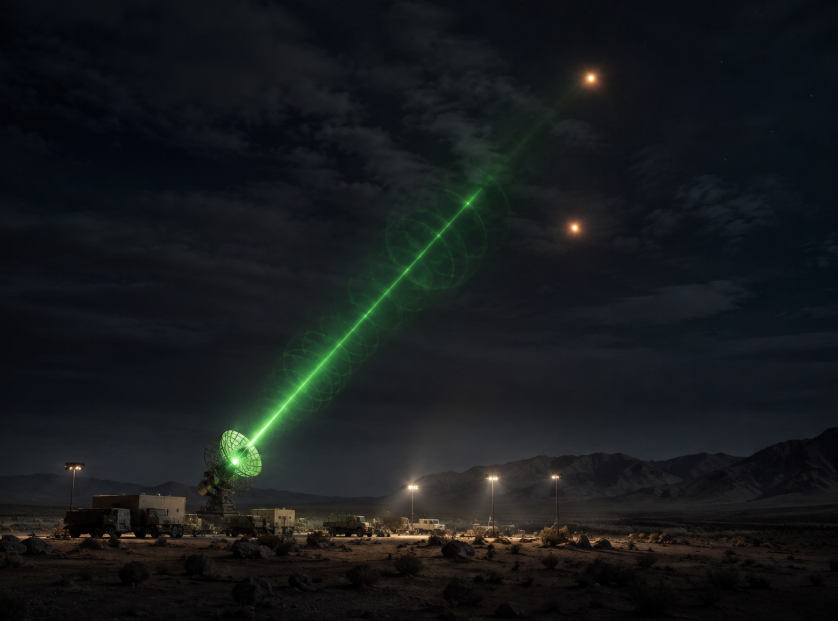
The first UAP was easy to argue about. A rocket had launched, sound had been broadcast, and too many variables were active at once to know what mattered. So the team changed the experiment. They removed the rocket, isolated the acoustic stimulus, and tried again. Then another unexplained object appeared. One event could be coincidence. A second response after the team deliberately narrowed the trigger is much harder to ignore.
THE FIRST UAP APPEARS BUT TOO MANY THINGS HAPPENED AT ONCE
The first sighting should have been a breakthrough, but instead it created a problem. During the East Field experiment, the team was deliberately provoking a suspected anomaly with more than one form of stimulation. Rockets were being launched through the anomalous region while acoustic frequencies were also projected into the area. Then an unexplained aerial object appeared. The timing immediately looked suspicious, but scientifically it was messy. If the UAP had been triggered by the experiment, which part had done it? Was it the rocket physically penetrating the anomalous zone? Was it the sound energy? Was it the combination of both? Or had the object simply appeared at the same moment by chance?

That uncertainty prevented the team from treating the sighting as evidence of a clean response. It was dramatic, but it was not isolated. Erik Bard understood the problem: when several variables are changed simultaneously, even an extraordinary result can become difficult to interpret. The only way forward was to strip the experiment down. The team needed to remove one of the major stimuli and see whether the phenomenon returned. That decision changed the stakes completely. They were no longer simply hoping to witness another UAP. They were testing whether the ranch would respond when given a more controlled input. Rockets could be eliminated. Sound could remain. If nothing happened, the first event might lean toward coincidence or a rocket-related trigger. But if another UAP appeared after acoustic stimulation alone, the pattern would become much more difficult to dismiss. For once, the most important moment was not the first unexplained object. It was whether the ranch would repeat itself when the team deliberately asked the same question in a cleaner way.
THE ROCKET IS REMOVED THE SOUND REMAINS AND ANOTHER UAP APPEARS
The second experiment was powerful precisely because it was simpler. Instead of combining rockets with acoustic stimulation, the team focused on sound. Frequencies were swept through the East Field while investigators watched for any corresponding change in the environment. Then one frequency stood out: 192 Hz. Travis Taylor said he could feel it intensely through his feet, and the vibration seemed strong enough that the ground itself became part of the experiment. The tone was physically noticeable in a way the surrounding frequencies had not been. And then the sequence repeated. Another unexplained light appeared overhead. This time, there was no rocket crossing the anomaly at that critical moment to confuse the interpretation. The acoustic stimulus had been isolated more cleanly, and a second UAP-like event followed.

That does not prove 192 Hz caused the object to appear. An aerial sighting can coincide with an experiment without being produced by it, and any serious conclusion would require repeated controlled trials. But the significance lies in what the team had changed between the two events. The first time, rockets and sound were mixed together. The second time, the investigators intentionally reduced the variables and the phenomenon still appeared. That is exactly the kind of repetition that turns a strange observation into a hypothesis. The first UAP could be treated as noise inside an overly complicated test. The second sighting suggests that at least one part of the original stimulus may have mattered. Suddenly, the experiment was no longer about a mysterious object happening to cross the sky. It was about whether the team had begun isolating a trigger.
THE SECOND RESPONSE CHANGES EVERYTHING BECAUSE NOW THE TEAM CAN TRY TO MAKE IT HAPPEN AGAIN
That is why the second UAP may ultimately matter more than the first. Skinwalker Ranch has produced countless strange events, but its greatest defense against explanation has always been unpredictability. Something happens once, disappears, and refuses to return under the same conditions. Without repetition, investigators are left arguing over footage rather than testing a mechanism. The East Field sequence offers a way out of that trap. The team now has a possible progression: a UAP appears during a mixed rocket and sound experiment; investigators remove the rocket variable; sound is used again; 192 Hz stands out physically; another UAP appears. The next step becomes brutally clear. Repeat the acoustic test under tighter controls. Broadcast 192 Hz without rockets. Use neighboring frequencies as comparisons. Run silent control periods. Synchronize high-speed cameras, radar, thermal imaging, RF monitors, and GPS systems. Then record exactly when any unexplained object appears. If UAP activity continues clustering around 192 Hz while control periods remain quiet, coincidence becomes increasingly difficult to maintain as the only explanation. If nothing happens, the hypothesis weakens. Either result moves the investigation forward.

But if the response occurs a third time, the implications could be enormous. The team may have found a way to shift Skinwalker Ranch from observation into experimentation from waiting for the phenomenon to choose the moment to deliberately presenting a stimulus and measuring what comes next. That would be a fundamental change in the hunt. One UAP after a complicated experiment can be dismissed. Two after the team begins isolating the trigger create a pattern. A third under controlled conditions could become a breakthrough. The ranch has spent years forcing investigators to chase events after they happen. Now, for the first time, the team may be closing in on something much more dangerous: a way to make the mystery repeat itself.


