
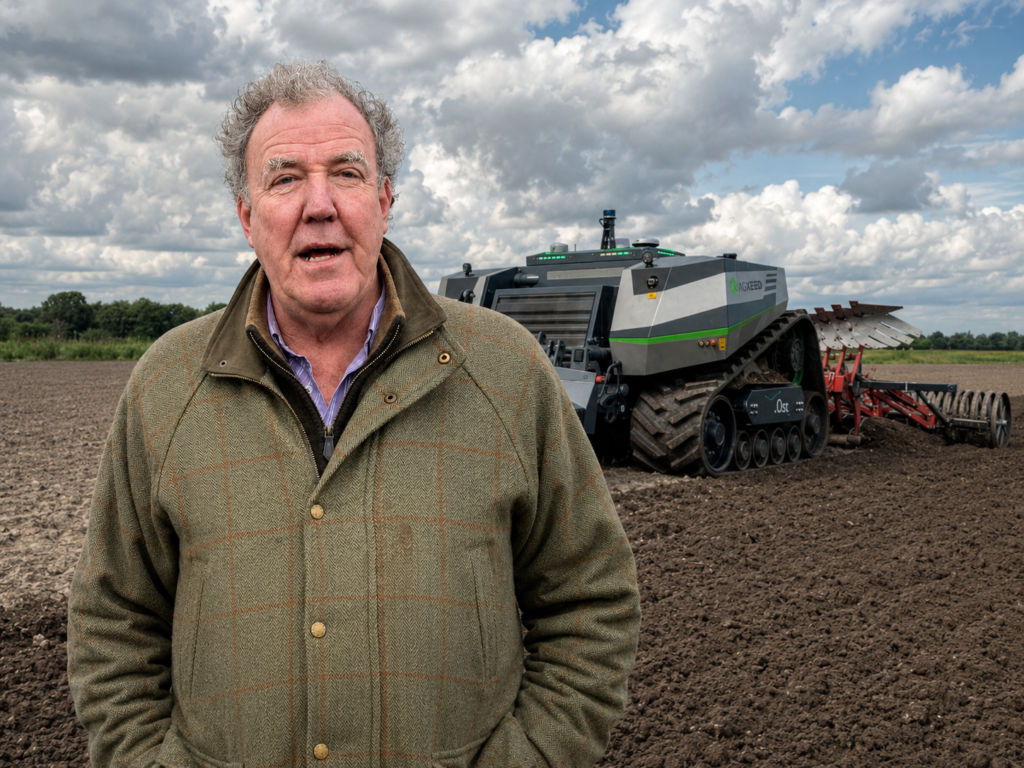
Jeremy Clarkson has spent years trying to improve Diddly Squat with bigger tractors, stranger experiments and the unwavering belief that the next piece of machinery will finally make farming straightforward. His latest move is different. By leasing an AgXeed AgBot T2, Clarkson is testing whether an autonomous tractor can remove some of the wasted time and human error from preparing and drilling his fields. It is expensive, unfamiliar and already capable of making Kaleb Cooper nervous but it could represent one of Diddly Squat’s most important technological shifts yet.
Clarkson’s Next Farming Experiment Removes Clarkson From the Tractor
For once, Jeremy’s argument for buying or more accurately, leasing an enormous machine begins with an admission that is difficult to dispute: Jeremy Clarkson is part of the efficiency problem. Preparing around 200 acres for cropping with a three-metre cultivator can take roughly 20 hours, followed by another ten hours to drill the seed. That means around 30 hours sitting in a tractor going repeatedly up and down fields, and Jeremy has freely acknowledged that five years of practice have not transformed him into the agricultural equivalent of a precision instrument. He can miss sections, make poor turns and occasionally discover far too late that a hopper has emptied while he has continued enthusiastically planting absolutely nothing. The AgBot T2 attacks exactly those weaknesses. The nine-tonne autonomous machine can travel through a field

without a driver sitting inside it, pulling implements for cultivation, drilling and other jobs while following a planned route. Once it is working, the operator does not have to spend every minute bouncing across the field with it. That makes the potential gain larger than simply replacing Jeremy’s hands on a steering wheel. If the AgBot can spend hours performing repetitive cultivation accurately, Jeremy and the rest of the team can use that time elsewhere. On a farm where livestock, the shop, The Farmer’s Dog and an expanding collection of businesses are already competing for attention, labour saved in one place potentially becomes labour available somewhere more valuable. Clarkson’s enthusiasm therefore has some logic behind it. This is not simply another giant machine bought because it looks impressive parked beside a barn. It is an attempt to change how Diddly Squat uses one of farming’s most limited resources: time.
Read more: https://showscope.truyengi.me/jeremy-clarksons-quiet-thanks-to-lisa/tqh/
Precision Drilling Could Matter More Than the Driverless Technology
The most interesting part of Clarkson’s AgBot experiment may not actually be that nobody is driving it. Diddly Squat has also been using detailed soil information to understand how conditions vary across individual fields. Mapping can show areas where the soil is stronger and more productive and other sections where it is thinner or less promising. Feeding that information into the equipment behind the AgBot opens the possibility of variable-rate or precision drilling: putting more seed where conditions justify it and reducing the rate where the soil is less capable of supporting the same population. That is a very different farming philosophy from simply treating every acre as identical. If it works, the benefit could come through better use of seed and inputs, more consistent operations and fewer mistakes created through fatigue or imperfect

driving. An autonomous tractor does not get bored halfway through a repetitive job. It does not need to stop because the driver wants dinner. And, crucially for Diddly Squat, it does not become distracted while Jeremy explains something unrelated. Yet the technology does not automatically guarantee a better harvest. Crop performance still depends on rainfall, soil conditions, disease, timing and dozens of variables no computer can command. Clarkson has also acknowledged that autonomous equipment is exceptionally expensive, which is why he chose to lease the AgBot rather than simply purchase it outright. That cost explains Kaleb’s scepticism as much as the obvious joke about robots stealing his job. A machine can perform repetitive field work, but somebody still needs to understand when that work should happen, what the soil requires and whether the conditions are suitable. Kaleb’s expertise therefore becomes more valuable rather than instantly redundant. The real question is not whether an AgBot can replace a farmer. It is whether it can remove enough repetitive driving to let the farmer concentrate on decisions that actually require experience.
Diddly Squat Is Testing a Future Most Farmers Cannot Yet Afford
That makes Clarkson’s decision interesting beyond the boundaries of his own farm. British agriculture is under constant pressure to produce more efficiently while controlling labour, fuel and input costs. Autonomous equipment offers an attractive answer in theory: machines can perform repetitive operations with high precision, work for longer periods and allow a smaller number of people to supervise more acreage. But there is a brutal contradiction. The farms that could benefit most from greater efficiency are often the same farms least able to spend hundreds of thousands of pounds experimenting with technology whose financial return may take years to establish. Clarkson can lease an AgBot, test it publicly and absorb the possibility that the experiment does not produce the expected result. An ordinary farmer has to calculate whether the savings in labour, seed, overlaps and mistakes could ever justify that level of investment. Diddly Squat therefore becomes something unusually useful: a highly visible test site for technology that much of the industry is watching but cannot casually afford. The outcome should not be judged simply by whether one harvest produces more grain. The better questions are whether the AgBot saves meaningful working hours, reduces avoidable

errors, improves the use of inputs and proves reliable enough during narrow weather windows when a breakdown can erase every theoretical advantage. Based on what Clarkson has said so far, he clearly believes autonomous tractors belong in farming’s future, while Kaleb’s concerns highlight the practical and human questions that inevitably follow automation. Neither side needs to be completely wrong. The AgBot can replace hours spent driving without replacing the knowledge required to farm the land. That distinction may become increasingly important at Diddly Squat. Clarkson began his farming career believing the answer was a tractor enormous enough to solve everything by horsepower. Years later, his potentially more important machine is one that does not need him sitting in it at all. Whether it improves the next harvest remains uncertain but if it does, Clarkson may finally have discovered a farming technology whose greatest feature is removing Jeremy Clarkson from the driver’s seat.






