
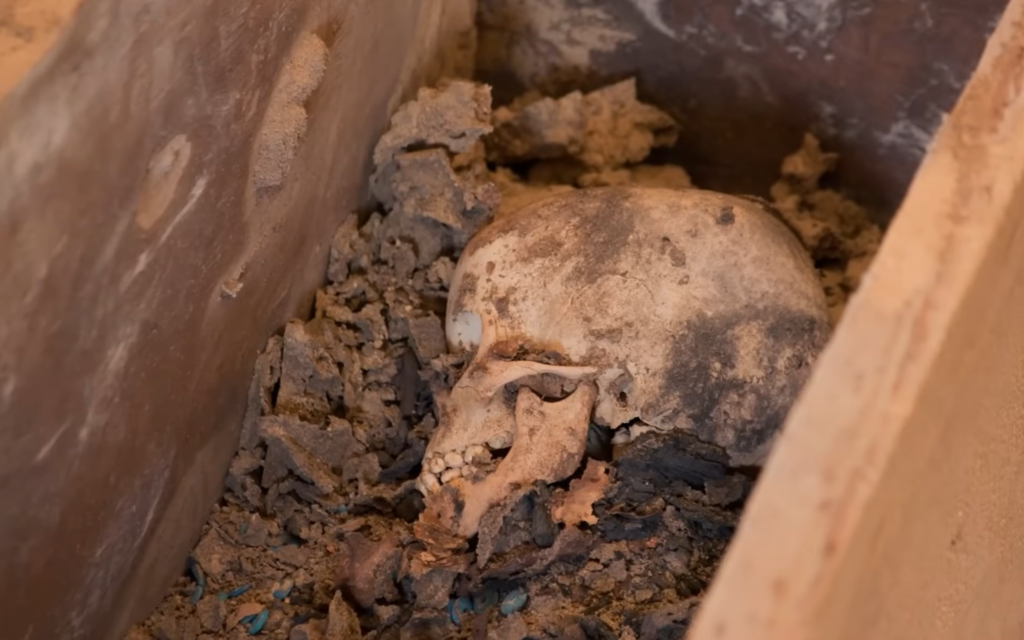
What if the small coffin found near the surface was only the first layer of a much larger secret? Expedition Unknown follows Josh Gates deeper into an ancient Egyptian burial complex, where mudbrick, limestone, and sediment suddenly give way to a painted underground vault. The chamber may hold something far more important than another burial—something that could expose what happened when Egypt’s Old Kingdom began to fracture.
The Small Coffin Was Only the Beginning
The discovery of a small coffin near the upper levels of the burial shaft already revealed how later generations returned to an ancient cemetery long after its original builders were gone. But as Josh Gates and the archaeological team continue descending, the excavation becomes increasingly difficult. Mudbrick, limestone, and dense sediment conceal the deeper architecture, forcing the team to remove layer after layer before they finally break into something completely unexpected.
A hidden vault opens beneath the earlier burial levels.

Unlike the rougher passages around it, the newly exposed chamber is remarkably preserved, with surfaces covered in painted decoration. After centuries underground, the walls suddenly emerge from darkness, transforming the excavation from a search for individual burials into a journey through an entire period of Egyptian history. The chamber appears connected to the ancient burial complex, but its exact role remains uncertain—and that uncertainty is what makes the discovery so significant.
The team is no longer looking only at who was buried here.
They are looking at what this place represented when Egypt itself was changing.
A Painted Chamber Opens a Door Into Egypt’s Collapse
The deeper significance of the vault comes from its possible connection to the turbulent period surrounding the collapse of the Old Kingdom. For centuries, Egypt had depended on powerful centralized authority, monumental construction, and a ruling elite capable of controlling enormous resources. But when that system began to weaken, the traditions surrounding death and burial would have been forced to change with it.
The painted chamber may provide a rare glimpse into that transition.
One provocative possibility is that the vault was not used exclusively as a burial chamber. During a period of political instability, it may have served to protect ritual objects, records, valuables, or other materials while the old political order was breaking apart. That interpretation remains hypothetical, but the architecture creates a compelling question: if monumental tombs represented stability and eternal power, what happened to the things considered too important to abandon when that stability disappeared?

The answer may be written on the walls.
If the paintings preserve inscriptions, symbols, or scenes that have survived in unusually good condition, the chamber could provide direct evidence of how Egyptians understood death and authority during one of the most disruptive transitions in their history. The discovery would therefore matter far beyond the tomb itself. It could connect the physical remains of burial practices with the larger collapse of the society that created them.
The Vault May Preserve the Moment Egypt Began to Break Apart
This is where the overlapping burials become far more meaningful. A child placed near the remains of an older burial complex, later generations returning to ancient tombs, and a painted chamber preserved beneath the accumulated layers could represent something much larger than repeated funerals. Together, they may record how a civilization adapted after its political system began to fail.
The idea that the chamber stored records or valuables remains unproven, and there is no evidence yet that it contains a hidden archive. But if the vault preserves original paintings or inscriptions connected to the final stages of the Old Kingdom, the discovery could become one of the most valuable pieces of evidence in the entire investigation.
Because gold can reveal wealth.
A tomb can reveal status.
But a painted wall can reveal how people understood the world while it was falling apart.
For Expedition Unknown, that may be the true prize buried beneath the small coffin. The chamber could show how one generation inherited the monuments of a powerful civilization while another struggled to preserve its traditions through political collapse and social upheaval.
And if the walls still contain a message that historians have never seen…
The greatest discovery may not be what was buried inside the vault.
It may be the story the vault was built to preserve.


