
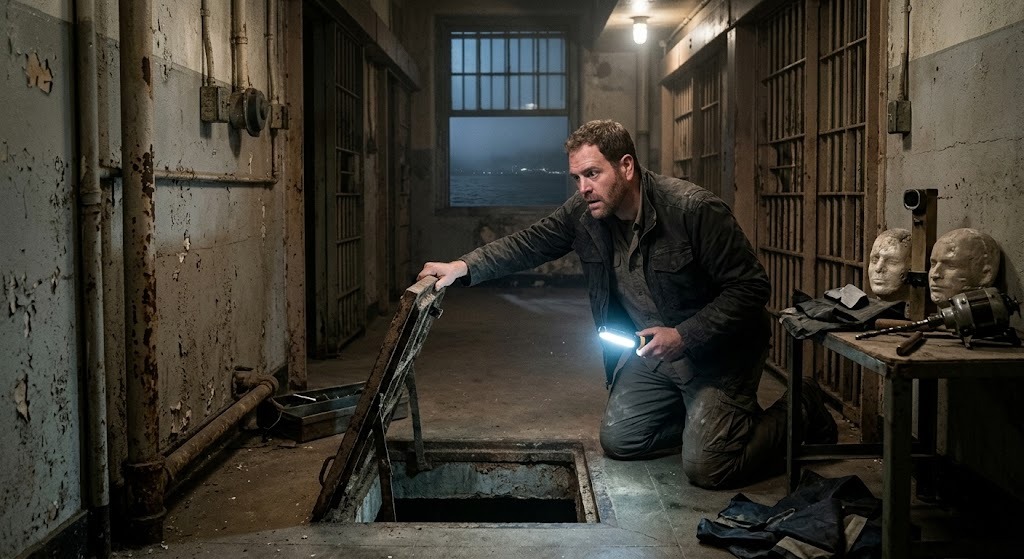
What if the famous Alcatraz escape was never designed to end in the water? Expedition Unknown follows Josh Gates into the abandoned prison corridors where raincoats, a homemade periscope, dummy heads, and improvised tools reveal a months-long operation far more sophisticated than a desperate dash for freedom. The deeper the team examines the plan, the more the final destination begins to look like the real mystery.
The Escape Was Built With More Than Desperation
The Alcatraz escape has become one of America’s most enduring prison mysteries, but the objects left behind suggest something far more calculated than a reckless attempt to cross San Francisco Bay. Three dummy heads were positioned on the beds to deceive guards during inspections, while raincoats were transformed into flotation equipment. Elsewhere, the escapees constructed a homemade periscope and even built a makeshift drill using a vacuum-cleaner motor, turning ordinary prison materials into tools for a highly organized operation. Each object reveals another layer of planning, and together they suggest that the men spent months preparing for a specific sequence of movements rather than simply improvising when the final night arrived.

The hidden workshop and access to utility corridors make the operation even more remarkable. The escapees were not merely breaking through a wall. They were creating an underground system in which tools, disguises, observation equipment, and escape gear all had specific functions. The periscope is particularly revealing because it demonstrates that they wanted to monitor conditions outside before committing themselves. That level of preparation suggests the water crossing was only one stage of a larger plan.
The Raft May Have Been Only the First Step
The most intriguing possibility is that the improvised raft was never intended to carry the men all the way to freedom. It may have been designed only to get them away from Alcatraz and across the most dangerous initial stretch of the escape. Once beyond the island, they could have reached another transfer point, hidden the flotation gear, or continued through a land-based route already prepared beyond the bay. There is no evidence proving such a second stage existed, but the sophistication of the prison workshop makes the idea difficult to dismiss outright.
The men had already demonstrated that they understood the importance of preparation. They built a periscope to observe the outside world and fashioned flotation equipment from raincoats. If they anticipated the possibility of currents sweeping them off course, then a simple raft would have been a risky first-stage tool rather than a guaranteed final vehicle. That distinction changes the central question surrounding the escape. Instead of asking whether the raft could reach shore, investigators must consider whether reaching shore was ever the actual objective.
And that opens a far more provocative possibility: someone may have been waiting beyond the water.
Who Was Waiting on the Other Side?
The theory of outside assistance remains unproven, but it offers a striking explanation for why the escape plan appears to extend beyond the prison walls. If the three men expected to reach another point on the mainland, they may have needed transportation, shelter, clothing, or a prearranged route to disappear before authorities could react. In that scenario, the currents of the bay were not simply an obstacle. They were part of a final gamble—one that could either carry the men toward freedom or scatter the evidence of what happened to them.

The available evidence does not establish that the escapees survived, nor does it confirm that anyone was waiting for them on the other side. But the abandoned workshop, improvised equipment, and careful deception leave open a darker possibility: the raft may have been only the visible portion of a much larger escape system. If so, the missing men did not necessarily disappear because the water killed them. They may have disappeared because someone helped them vanish.
For Expedition Unknown, that transforms the Alcatraz mystery from a question of survival into a question of coordination.
Because the real escape may not have ended at the shoreline.
It may have begun there.
And if someone was waiting on the other side of the bay…
The greatest Alcatraz mystery is no longer where the three men went.
It is who was waiting for them.


