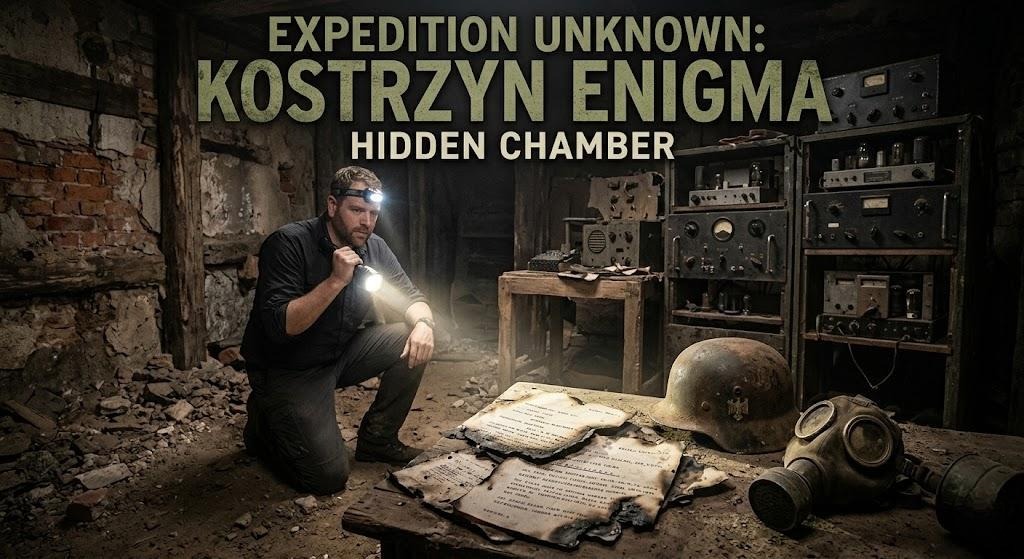
What if the ruins beneath Kostrzyn preserved more than the remains of a destroyed city? As Josh Gates and the excavation team enter a buried chamber containing electrical equipment, radio-related evidence, military gear, and burned papers apparently connected to Enigma, a far more complicated picture begins to emerge. The deeper mystery is not simply what the room contained—but why its secrets survived when almost everything around it was destroyed.
The Chamber Beneath the Ruins
Kostrzyn, remembered as the “Polish Pompeii,” was devastated during the final stages of World War II, leaving entire sections of the city buried beneath layers of rubble and earth. But that destruction may have created an unexpected archaeological time capsule. As Josh Gates and the excavation team work through the buried structures, they reach a chamber containing electrical equipment and signs of radio activity, alongside a German helmet and gas mask. Each object is significant on its own, but together they suggest that this was more than an abandoned room. Someone was operating here, communicating here, and working within a military environment that disappeared beneath the ruins before the outside world could fully understand what had been left behind.

The most intriguing clues are the burned papers apparently associated with Enigma, prisoners, and a nearby Stalag. Their damaged condition makes them frustratingly incomplete, yet that may be exactly what makes them so important. Instead of providing a simple answer, the fragments open a much larger question about what happened inside this buried section of Kostrzyn during the final days of the war.
Where Communications Met the Prison System
The combination of radio-related equipment, military objects, and documents apparently referencing prisoners suggests a possible connection between several layers of wartime activity. Could this chamber have served as a point where military communications, intelligence, and prisoner administration intersected? The available evidence does not prove that conclusion, but the physical arrangement creates an intriguing line of investigation.

The destruction of Kostrzyn may hold part of the explanation. As the city became a battlefield and buildings collapsed, rooms that might otherwise have been cleared, searched, or repurposed were suddenly sealed beneath tons of debris. A record room, communications station, or administrative space could have disappeared almost overnight, taking its contents with it. What was once an ordinary working environment may have become an accidental archive, preserved not because anyone intended to protect it, but because the destruction made it unreachable.
And that raises an even more compelling possibility: perhaps the most important information was never destroyed at all.
It was simply buried.
Could Kostrzyn Still Be Hiding the Missing Pieces?
The burned documents create the most tantalizing question of all. If the surviving fragments really are connected to Enigma-encrypted communications and prisoner movements, they could represent only a small portion of a much larger documentary record. Somewhere beneath the destroyed city, additional papers, equipment, or related rooms could still exist, waiting beneath ground that has never been fully excavated.
There is no evidence yet that an intact collection of classified records remains hidden beneath Kostrzyn, nor that the surviving fragments contain an undiscovered Enigma key. But the possibility gives the excavation a significance that extends beyond a single buried chamber. The site may preserve a rare physical connection between military communications and the human administration of wartime prisoners during the chaotic final phase of the conflict.
Perhaps the greatest discovery is not a weapon, a machine, or a forgotten command center.
Perhaps it is a fragment of information.
Because Kostrzyn did not simply bury its buildings.
It may have buried part of the story of what happened inside them.
And somewhere beneath the ruins, the missing pieces may still be waiting to be uncovered.