
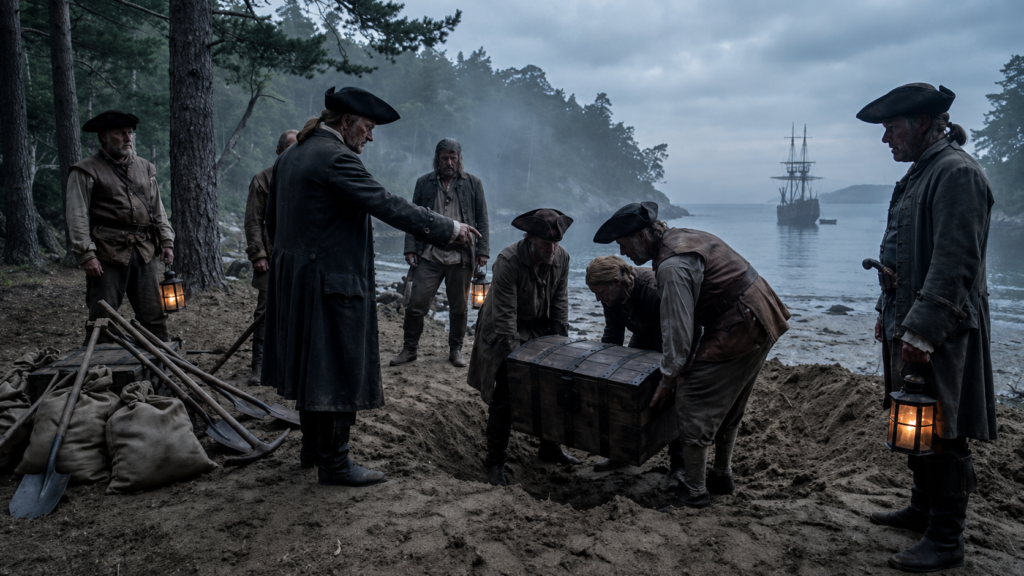
For generations, the pirate theory has offered Oak Island its most irresistible image: a desperate crew arriving under darkness, dragging stolen wealth ashore, and burying it where no navy, rival captain, or betrayed accomplice could ever recover it. Captain Kidd and other infamous names have become almost inseparable from the legend. Yet one old detail now threatens to turn that dramatic story against itself. The deeper investigators examine the engineering described beneath the island, the harder it becomes to believe that ordinary pirates could have built it and the collapse of that theory may point toward a far more organized and powerful group.
The Pirate Story Begins to Break Under Its Own Weight
The pirate explanation survives because it feels simple. Pirates possessed stolen treasure, feared capture, and needed secret places where valuable cargo could disappear. An isolated island off the coast of Nova Scotia appears to provide the perfect setting. A ship could approach quietly, men could move chests inland, and the location could be marked for a later return. The mystery seems almost complete before the first shovel enters the ground. It is dangerous, cinematic, and easy to understand. More importantly, it gives the Money Pit an immediate motive. Someone had treasure. Someone needed to hide it. Oak Island became the hiding place.
But the same simplicity that makes the theory attractive may also expose its fatal weakness. Historical pirates rarely had the luxury of treating buried wealth like a permanent engineering project. They lived under pursuit, internal betrayal, violent competition, and the constant possibility that their ships would be captured or destroyed. If treasure was hidden, speed mattered. Secrecy mattered. The ability to return quickly mattered. A shallow pit near a recognizable landmark would serve those needs. A complicated underground system involving deep shafts, layered platforms, carefully selected materials, possible tunnels, drainage features, and extensive surveying would not. Every additional day spent on land would increase the risk of discovery, desertion, mutiny, or interception. Every extra worker would become another person capable of revealing the location.

That contradiction becomes more severe when the alleged complexity of the Money Pit is considered. The traditional account does not describe a hurried hole dug by exhausted sailors. It describes a descending structure with repeated layers appearing at measured intervals, foreign materials, and possible mechanisms designed to protect or conceal whatever had been placed below. Even if parts of that story were altered through repetition, the broader mystery still points toward deliberate effort. The depositors may have needed to understand the terrain, groundwater, soil behavior, and the relationship between the shore and the central excavation area. That requires more than a few men with shovels and a stolen chest.
The pirate theory therefore faces a dangerous question it has avoided for years: why would fugitives create something so difficult to build and even more difficult to recover? A pirate captain hiding treasure usually intended to reclaim it. The more elaborate the system became, the greater the chance that even its creators would lose access to their own fortune. If Oak Island contains evidence of advanced concealment, the builders may not have been improvising under pressure. They may have been executing a planned operation with objectives far greater than simply hiding loot until the danger passed.
The Engineering Suggests a Mission, Not a Getaway
Building a serious underground structure on Oak Island would have demanded preparation long before the first excavation began. Someone needed to choose the location, determine the depth, organize labor, transport tools, secure supplies, and maintain secrecy while the work continued. If flood-control or flood-triggering features were involved, the builders would also have needed knowledge of tides, coastal geology, and underground water movement. None of those tasks fits comfortably with the popular image of pirates rushing ashore after a raid. They suggest planning, discipline, and a command structure capable of keeping many people focused on one concealed objective.
The labor problem alone threatens the pirate explanation. A deep shaft could not be created safely by a tiny landing party working for a single night. Soil and rock would need to be removed, lifted, transported, and hidden. Timber would have to be cut, shaped, and lowered into position. Workers would require food, shelter, tools, and protection. If tunnels connected the excavation to the shoreline, the amount of displaced material would become enormous. Such an operation could last weeks, months, or possibly longer depending on its true scale. The builders would need confidence that they controlled the island and its surrounding waters. Pirates, whose survival depended on mobility, would be taking an extraordinary risk by remaining in one location.

There is also the question of expertise. Sailors possessed valuable practical skills. They understood ropes, timber, navigation, repairs, and survival under extreme conditions. Some pirates may have included former naval officers, carpenters, engineers, or miners. That cannot be dismissed. But possessing individual skills is not the same as organizing a large, integrated underground project. The Money Pit tradition implies coordination between design, labor, materials, and concealment. It suggests that the builders knew not merely how to dig, but how to make later searchers misunderstand what they were seeing.
That difference changes the meaning of Oak Island. A pirate burial is a hiding place. An engineered complex is a mission. One exists because criminals need to escape with the possibility of returning. The other exists because an organization has chosen a location for a specific long-term purpose. It may have been designed to protect valuables, sacred objects, political documents, military resources, or evidence considered too dangerous to remain in the known world. The engineering does not prove which possibility is correct, but it raises the level of the mystery. The builders may have been acting with authority, resources, and an expectation that their secret needed to survive for generations.
If that interpretation is correct, Captain Kidd may have become attached to Oak Island not because the physical evidence pointed directly toward him, but because his name offered the easiest story. A famous pirate creates instant excitement. A hidden organization requires more difficult questions. Who financed the operation? Who possessed the technical knowledge? Who could move men and materials without attracting attention? And what could have been valuable enough to justify the enormous effort?
If Pirates Did Not Build It, Someone Far More Powerful May Have
Once the ordinary pirate theory begins to collapse, Oak Island becomes more unsettling rather than less. Removing Captain Kidd does not remove the treasure. It removes the simplest explanation for how it arrived. The search then moves away from isolated criminals and toward institutions capable of planning across borders and generations. Military orders, wealthy political networks, secret religious groups, state-backed expeditions, and commercial organizations all become more difficult to ignore. Each possibility carries its own problems, but all share one important advantage over the pirate theory: they could command the labor, money, discipline, and secrecy required for a major construction project.
A powerful group would also have a different relationship with time. Pirates needed speed because danger followed them. An organized institution could plan a voyage, recruit specialists, gather materials, and occupy the island under a legitimate cover. Workers might believe they were constructing a fortification, storage site, settlement, or navigation facility without ever understanding the full purpose. Knowledge could be divided so that no single laborer possessed the entire secret. When the operation ended, records could be destroyed, hidden, or absorbed into archives where later generations would never recognize their importance.
This possibility could explain why the Oak Island mystery feels fragmented. Searchers have encountered pieces that appear to belong to different stories: old timbers, metal objects, stone features, traces of human activity, possible tunnels, and historical connections stretching across countries and centuries. The pirate theory attempts to compress those fragments into one dramatic event. A larger organization might explain why the evidence refuses to fit so neatly. The island may not have witnessed one frantic burial. It may have hosted a carefully staged operation whose purpose was understood only by a small number of people.

The danger for the Fellowship is that proving the pirate theory wrong would destroy one of Oak Island’s most familiar foundations without immediately replacing it. Years of speculation about Captain Kidd and stolen treasure could fall away, leaving Rick and Marty Lagina facing a mystery that has become broader, more expensive, and harder to contain. Every structure would need to be reconsidered. Every artifact might carry a different meaning. Evidence once treated as the remains of pirate activity could instead point toward logistics, military planning, religious secrecy, or political concealment.
Yet this collapse could also become the breakthrough the search has needed. Oak Island may have resisted discovery because investigators kept asking where pirates buried their treasure instead of asking what kind of organization could transform an island into a concealed engineering site. The answer may not be found by identifying a famous outlaw. It may emerge by reconstructing the operation itself: the manpower required, the materials transported, the knowledge used, and the authority necessary to keep the work hidden.
The old pirate story offered Oak Island romance. The engineering offers something more dangerous scale. If the underground features were deliberately created, then the people responsible may have possessed resources far beyond those of an ordinary pirate crew. They were not simply hiding from the world. They may have been acting on behalf of a power capable of controlling what the world was allowed to know. And if even part of that system still survives beneath the island, the Fellowship may be approaching evidence that will not merely challenge the legend of Captain Kidd. It could reveal that the greatest secret of Oak Island was protected by people whose identity has been hidden more successfully than the treasure itself.






