
For decades, the ocean kept the final chapter of a terrible World War II story hidden in darkness.
Somewhere beneath the waters off the Philippines lay the remains of a Japanese transport ship carrying more than 1,000 Allied prisoners of war. The men had already endured captivity, hunger, disease, exhaustion, and brutal conditions. Then came the sinking — and with it, another tragedy that would leave families waiting for answers for generations.
The ship was the Hōfuku Maru, one of the vessels remembered in the grim history of the Japanese “hell ships.” Its story was not simply about a ship disappearing beneath the waves. It was about hundreds of human lives being carried into an uncertain final chapter, while the location of the wreck itself remained difficult to establish.
That is where Josh Gates and the Expedition Unknown team entered the story.
What makes this investigation so powerful is not simply the eventual sighting of a wreck beneath the sea. It is the journey that came before it — the painstaking attempt to reconstruct the ship’s final movements through military records, historical documents, aerial imagery, and underwater technology.
The deeper Gates went into the investigation, the more the search began to feel less like a hunt for a ship and more like a search for a place where history had been waiting to be remembered.
THE SEARCH BEGINS WITH PAPER, NOT SONAR
When people imagine an expedition searching for a lost shipwreck, they often picture divers descending into dark water or a sonar screen suddenly revealing the outline of a forgotten vessel.
But the most important discoveries frequently happen long before anyone enters the ocean.
For Gates and his team, the first stage of the investigation was historical.
The challenge was to reconstruct what happened to the Hōfuku Maru during the final days of its wartime voyage. The ship was part of a brutal system in which prisoners of war were transported under appalling conditions aboard vessels that were often poorly equipped for the number of people they carried.
These ships became known as “hell ships” for a reason.

The prisoners were frequently packed into confined spaces with inadequate food, little ventilation, and almost no protection from disease or the dangers of wartime attacks. The journey itself could become a fight for survival.
For the team, understanding that history was essential.
A shipwreck search cannot begin with a random patch of ocean. The investigators needed to establish where the vessel had been, what route it followed, what military events occurred in the area, and where the ship might have gone down.
That meant going back through records that had survived the war.
Military documents became pieces of a much larger puzzle. American and Japanese records offered different perspectives on the same events, while historical accounts helped the team narrow the timeline.
Then came one particularly intriguing clue: an aerial reconnaissance photograph.
At first glance, an old wartime photograph might not seem like the kind of evidence capable of solving a decades-old maritime mystery.
But that is the beauty of historical investigation.
A tiny detail preserved in an image can suddenly become more valuable than years of speculation.
The photograph potentially provided the team with a geographic reference point — a clue that could help transform the search from an enormous area of ocean into a much more manageable target.
For Gates, this was the moment when the investigation began moving from history toward exploration.
The documents had told them where to look.
Now they had to find out whether the ocean agreed.
THE SONAR IMAGE THAT CHANGED THE SEARCH
Once the historical evidence narrowed the search area, the investigation entered a completely different phase.
The team turned toward technology.
Sonar became their eyes beneath the surface.
The ocean floor can be an unforgiving place to search. A wreck does not necessarily sit exposed in perfect condition, waiting to be discovered. Sediment, darkness, currents, distance, and the enormous scale of the seabed can make even a large ship remarkably difficult to locate.
That is why the sonar survey became such a crucial moment.
The team began scanning the seabed, searching for something that did not belong there.
Then a large structure appeared.
It was not simply another ambiguous shape.

The target appeared clearly man-made.
And suddenly, the decades-old mystery had a physical location.
This is the kind of moment that makes an exploration story unforgettable — not because the answer arrives instantly, but because everyone in the room understands what the image could mean.
A shape on a screen can represent almost anything.
It could be debris.
It could be a geological formation.
It could be the remains of another vessel.
Or it could be the Hōfuku Maru.
That uncertainty is what makes the next step so important.
The team could not simply look at the sonar image and declare the mystery solved. They needed confirmation.
And confirmation meant going down.
For Gates, the expedition had reached the point where historical research and modern technology had taken them as far as they could go from the surface.
Now the final answer was waiting nearly 175 feet below.
INTO THE DARKNESS
There is something emotionally different about seeing a shipwreck on a screen and actually descending toward it.
A sonar image is evidence.
A dive is confrontation.
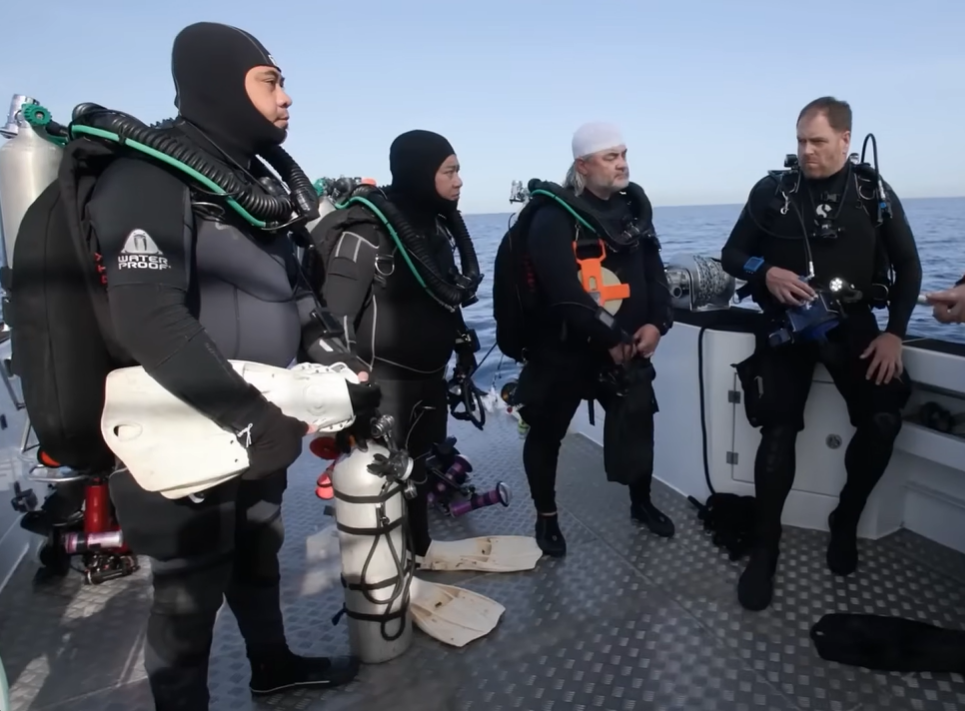
Josh Gates and a team of technical divers prepared to descend toward the target, carrying with them not only cameras and equipment but the weight of the story they had spent so long investigating.
Nearly 175 feet below the surface, the world changes.
Light disappears.
The surroundings become colder and darker.
Every movement has to be controlled.

Communication becomes more difficult, and the divers must rely on their training and equipment while managing the risks associated with deep-water exploration.
But beneath all of those technical challenges was another thought.
If the target was truly the Hōfuku Maru, they were approaching the final resting place of more than 1,000 prisoners of war.
That changes the meaning of the dive.
This was not simply an attempt to find an interesting shipwreck.
It was an attempt to identify a place connected to one of the darkest chapters of the Pacific War.
As the divers approached the structure, the sonar image began to become something tangible.
Metal.
Shape.
Architecture.
A vessel.
The mystery that had existed in documents and photographs was finally becoming visible beneath the sea.
For Gates, this is where the investigation reaches its emotional center.
The ship was no longer merely a name in a historical record.
It was there.
And the realization carries a strange mixture of excitement and sadness.
Because finding a wreck like this means finding history — but it also means confronting tragedy.
THE WRECK IS NOT THE END OF THE STORY
It would be easy to describe the discovery simply as a successful shipwreck hunt.
But that would miss the most important part.
The real significance of identifying the Hōfuku Maru is not the achievement of locating another wartime vessel.
It is what that location represents.
For decades, stories connected to the hell ships existed in photographs, military archives, survivor accounts, and family memories. The men who disappeared were not simply numbers in a historical document. They were sons, fathers, brothers, husbands, and friends.
Many families spent years living with incomplete knowledge.

There is a particular kind of pain in not knowing where someone’s story ended.
A name can remain in a family for generations, but without a final place, the memory can feel unfinished.
That is why discovering the wreck can carry meaning far beyond archaeology.
The ship becomes a memorial.
The seabed becomes a historical site.
And the investigation becomes an act of remembrance.
This is one of the qualities that makes Josh Gates’ work so compelling when Expedition Unknown moves into stories like this. The adventure is still there — the technology, the dangerous dives, the historical clues and the suspense of the search — but underneath everything is a much more human question.
Who were these people?
What did they experience?
And can modern exploration give their stories the recognition they deserve?
Those questions cannot be answered by sonar alone.
They require empathy.
WHEN HISTORY FINALLY HAS A PLACE TO REST
Perhaps the most powerful part of the Hōfuku Maru investigation is the way it demonstrates what exploration can accomplish when history and technology work together.
The search did not begin with a spectacular discovery.
It began with paperwork.
Then came old military records.
Then an aerial photograph.
Then coordinates.
Then sonar.
Then a descent into darkness.

Step by step, an event that had been buried beneath decades of uncertainty began to take physical form.
That progression is what makes the story so satisfying.
Josh Gates did not simply stumble across a wreck.
He followed a trail.
Every clue had to be examined. Every possibility had to be tested. Every technological breakthrough had to be followed by physical confirmation.
And at the end of that process stood a ship that had been missing from the visible world for generations.
For viewers, there is an almost haunting beauty in that moment.
The ocean had held the wreck in silence.
History had carried the names.
Families had carried the memories.
And finally, the expedition brought the two together.
The discovery cannot undo what happened during World War II. It cannot return the men who were lost. It cannot erase the suffering endured aboard the hell ships.
But it can give the story something it did not have before:
A place.
A location.
A physical connection to the past.
And sometimes, that is what remembrance needs most.
THE OCEAN GAVE BACK A PIECE OF THE STORY
The story of the Hōfuku Maru is ultimately bigger than a shipwreck.
It is a reminder that the ocean does not simply hide history. It preserves it.
For decades, the Pacific concealed the physical remains of a tragedy that had already been pushed into the distant past. But the clues never completely disappeared. They survived in military records, photographs, historical accounts, and memories.
Josh Gates and the Expedition Unknown team followed those fragments until they reached the place where the story had been waiting.
From the first document to the final descent, the investigation demonstrates why exploration still matters.
Sometimes the greatest discovery is not gold.

It is not treasure.
It is not an artifact destined for a museum.
Sometimes it is simply finding the place where a forgotten story ended.
And when that story belongs to more than 1,000 prisoners of war, finding that place becomes something much more profound than an expedition.
It becomes a way of saying that they were not forgotten.
After decades beneath the waves, the Hōfuku Maru can finally be seen not merely as a wreck, but as a silent memorial to the people whose lives became part of its history.
The sea kept them hidden for generations.
Josh Gates helped bring their story back into the light.


