
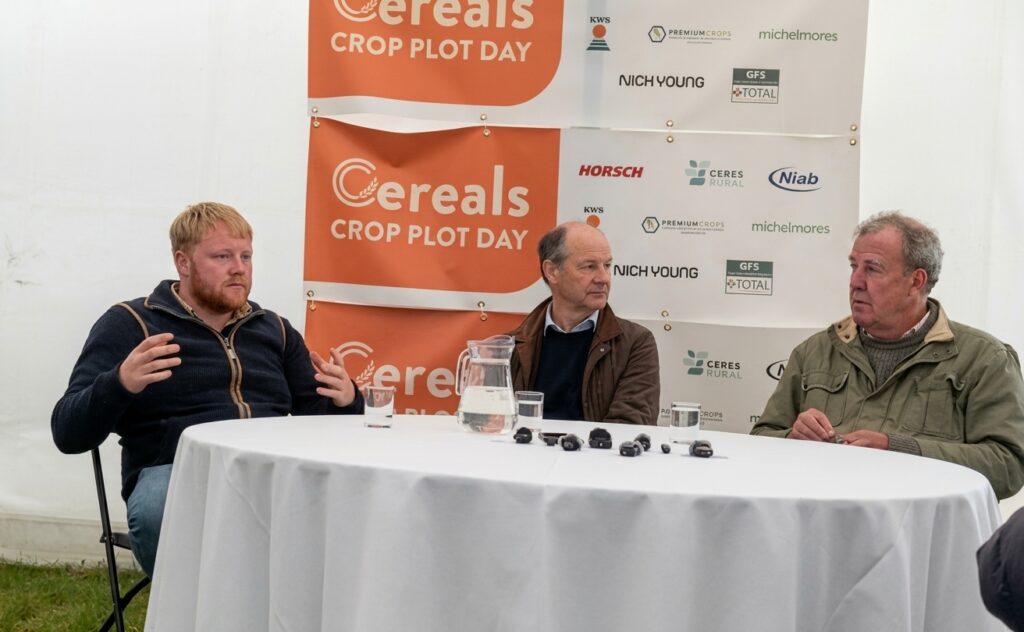
Kaleb Cooper built his reputation by standing beside Jeremy Clarkson and explaining, usually at considerable volume, why the latest Diddly Squat plan was about to fail. His new solo farming show changed that comfortable formula completely. There would be no Clarkson creating the chaos, no familiar Oxfordshire fields and nowhere for Kaleb to hide when the pressure arrived. For the young farmer who once disliked travelling beyond his local area, stepping out alone became the greatest opportunity of his career and the first time the entire weight of the programme rested on his shoulders.
Leaving Diddly Squat Meant Leaving Everything Familiar
Kaleb had become one of television’s most recognisable farmers without ever appearing to chase fame. He entered Clarkson’s Farm as a practical local contractor whose main concern was protecting the crops from a celebrity landowner armed with an oversized Lamborghini tractor and the confidence of a man who believed instructions were written for people with smaller personalities. The programme worked because Kaleb understood the land while Jeremy misunderstood almost everything else. Whenever a machine failed, a field flooded or a plan became financially ridiculous, Kaleb could react honestly and then return to the work he knew. A solo show removed that safety. Suddenly, he was not simply the expert correcting someone else’s mistakes; he was the person expected to carry the story, connect with unfamiliar farmers and prove that audiences would follow him beyond Diddly Squat. Travelling to Australia

for a new farming series pushed that challenge even further. Kaleb was leaving the small part of Oxfordshire where he had spent most of his life and entering an agricultural world operating on a scale that made Diddly Squat look like a vegetable patch behind a village hall. The journey itself created pressure. Kaleb had never hidden his dislike of flying or his preference for remaining close to home, his family and his own machinery. Yet the opportunity was too important to reject. Clarkson had opened the door to television, but this was Kaleb’s chance to walk through it without Jeremy beside him making the first avoidable mistake. It was exciting, but it also carried a frightening question: had viewers connected with Kaleb himself, or only with the arguments that erupted whenever Clarkson entered a tractor?
The Joke Was Over When Every Decision Became His
On Clarkson’s Farm, Kaleb can always rely on Jeremy to generate material. Clarkson announces something impossible, Charlie produces a terrifying estimate, Lisa asks the practical question everyone else avoided, and Kaleb reacts as though common sense has been formally abolished. A solo programme offers no such convenient disaster machine. Kaleb had to lead conversations, explain unfamiliar farming systems and remain engaging without turning himself into a polished television presenter who no longer sounded like the young farmer audiences trusted. That pressure followed him across enormous Australian properties where fields could stretch farther than his entire working world at home. Machinery was larger, distances were brutal and farmers faced conditions completely different from the rain-soaked battles of the Cotswolds. Kaleb could not simply arrive and behave as though British

farming contained every answer. He had to listen, adapt and accept being the inexperienced outsider the exact role Clarkson normally occupies at Diddly Squat. The reversal was both funny and uncomfortable. At home, Kaleb knows which gateway is too narrow and which patch of ground will swallow a tractor. Abroad, he was the man asking questions while local farmers watched him approach unfamiliar equipment with Jeremy-like enthusiasm. Behind the comedy sat a much heavier responsibility. The show carried his name, his reputation and his hope of building a career that could secure his family’s future. Every awkward moment belonged to him. Every scene that failed could not be rescued by Clarkson driving into a hedge. Kaleb also had to balance filming with the life he had left behind: his contracting business, the farm work and the wife and children who gave all that ambition a purpose. The opportunity promised growth, but it demanded absence, uncertainty and the exhausting task of being both a farmer and the central figure in a production built around him.
The Greatest Career Move Also Tested Who Kaleb Had Become
The importance of Kaleb’s solo show lies in what it represents rather than whether every challenge ended successfully. He began as the unknown young contractor who doubted Jeremy Clarkson could farm and soon discovered that doubt was the safest agricultural prediction anyone had ever made. Several seasons later, he had become an author, live performer, bonger be described only as Clarkson’s outspoken colleague. He had to demonstrate that his knowledge, humour and curiosity could support a story of their own. That transition carried enormous risk. Television audiences can be loyal to familiar relationships, and Kaleb’s arguments with Jeremy remain central to his appeal. Moving beyond them could strengthen his identity or expose how much he depended on the Diddly Squat formula. Yet the same honesty that made him memorable also gave the project its strongest foundation. Kaleb did not need to pretend that travelling alone felt easy or that every new experience left him completely confident. His discomfort became part of the journey. A farmer who had spent most of his life close to Chipping Norton was now crossing the world to understand how other people survived drought, scale, isolation and

financial pressure. Their machinery and weather were different, but their worries often sounded remarkably familiar. That discovery allowed Kaleb’s personal gamble to become a wider story about agriculture. Farmers everywhere carry responsibility for land, animals, workers and families while operating inside markets they cannot control. Kaleb’s new show gave him the chance to speak about that reality without standing in Clarkson’s shadow. The cost was that he had to leave the place where he felt strongest and accept being uncertain in public. Diddly Squat taught him to challenge Jeremy’s confidence; the solo show forced him to examine his own. It may be the biggest turning point of his career because, for the first time, Kaleb was not rescuing someone else’s programme. He was building his own and discovering that the most intimidating machine he had ever operated was the one with his name on it.






